ALeRCE has been processing alerts from the Zwicky Transient Facility (ZTF) since 2019, applying machine learning (ML) classification algorithms from the beginning and becoming an essential tool for users in more than 139 countries doing time-domain astrophysics. Building on this experience, ALeRCE was selected as Community Broker for the Vera C. Rubin Observatory and its Legacy Survey of Space and Time (LSST) in 2021 after an open call in 2020.
ALeRCE’s success in the ZTF era was due to a combination of simple user interfaces (ZTF Explorer and SN Hunter); ML algorithms such as an image stamp classifier (Carrasco-Davis et al. 2020), an alert light curve based classifier (Sánchez-Sáez et al. 2020), a host galaxy identification algorithm (Förster et al. 2022), and a forced photometry light curve classifier (Cabrera-Vives et al. 2024); simple data access tools such as a Python client, an Application Programming Interface (API), and direct database connection documented in usecase notebooks.
In the LSST era, ALeRCE aims to replicate the earlier success via an extension of the previous tools and the introduction of new tools.
Products offered by ALeRCE with LSST
At the start of LSST, ALeRCE is providing a new, modified LSST Explorer that is able to display multiple bands in a user-friendly manner, a modified Python client and API that can work with both ZTF and LSST data, and is introducing a new Table Access Protocol (TAP) service to query our database using Virtual Observatory standards and with enhanced interoperability. ALeRCE will also be offering a new version of the stamp classifier trained with real image stamps obtained during an LSST commissioning period. Once the stamp classifier is thoroughly tested in production, we will introduce a new version of the SN Hunter and will start to submit candidates to the Transient Name Server (TNS).
ALeRCE’s philosophy is to only train and put in production models based on real data. Thus, as time passes and our database is populated, ALeRCE will collect real light curves and will introduce a forced photometry light curve classifier that will be continuously updated. Further services will be introduced as our team becomes more experienced with real Rubin data.
List of ALeRCE LSST services
| Service | Description | Availability | |
| LSST Explorer | A modified Explorer that allows users to easily visualize with complex multiband lightcurves and other information | Available | |
| Python Client | A modified Python client to query our database for both ZTF and LSST data | Available | |
| API | A modified API to query our database for both ZTF and LSST data | Available | |
| TAP service | Table Access Protocol to directly query the ALeRCE database following VO standards and with enhanced interoperability | Available | |
| Image stamp classifier | A new deep learning image stamp classifier based on real LSST alert data | Preliminary beta version available | |
| LSST SN Hunter | A modified SN Hunter with thoroughly tested image stamp classifiers | Estimated for April 2026 | |
| Forced photometry light curve classifier | A new forced photometry light curve classifier based on real LSST alerts and associated forced photometry | A few months after the start of LSST alerts | |
Rubin data
Rubin’s data is different to that from ZTF: it contains more bands, it goes deeper, it covers mostly the southern sky, and it is based on an alt-azimutal rather than equatorial mount and on a different pipeline. As a consequence, there is more than an order of magnitude increase in the number of alerts, and image stamps come in more bands and with a variable in size and orientation, as can be seen in the following animation:
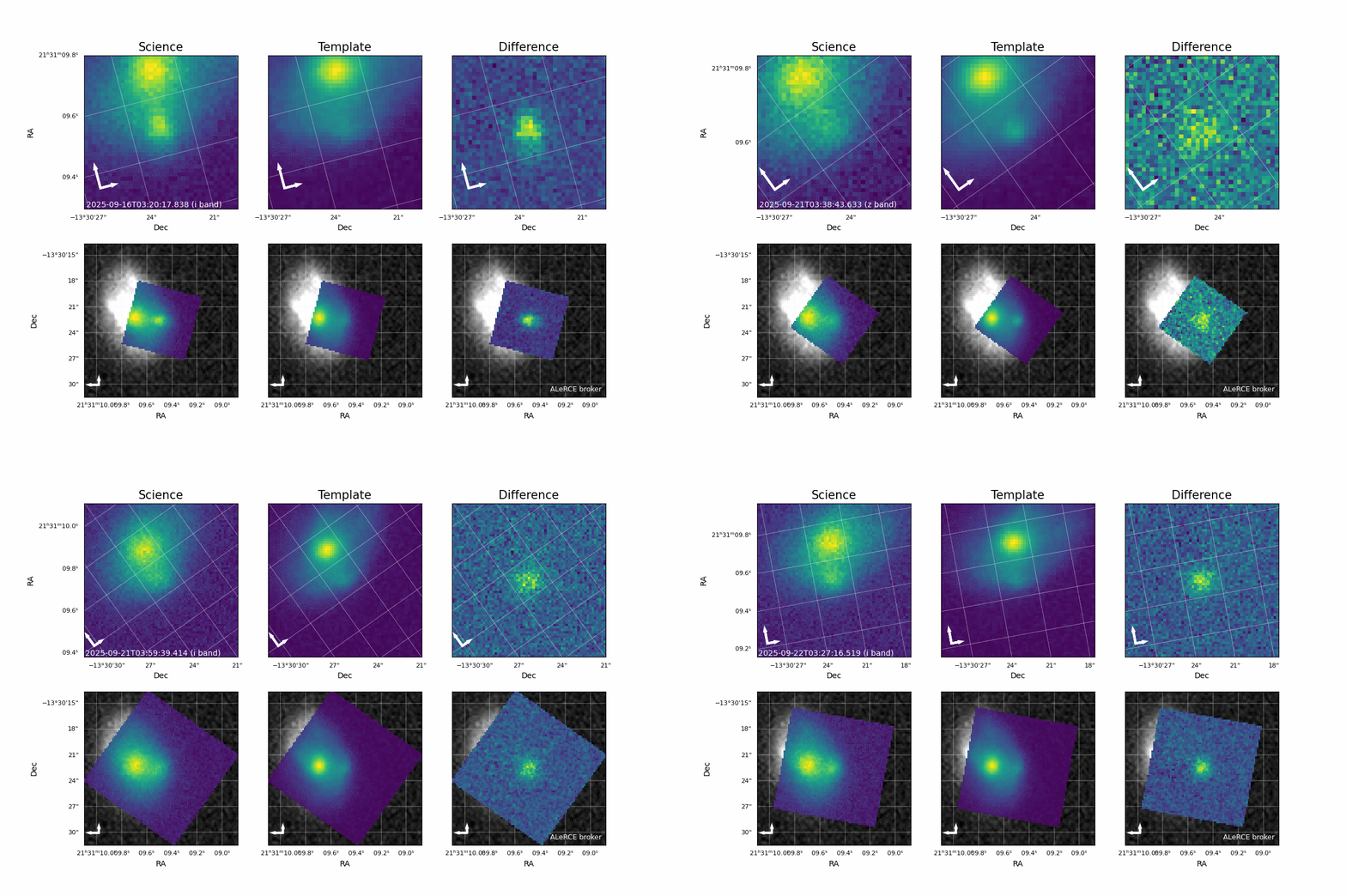
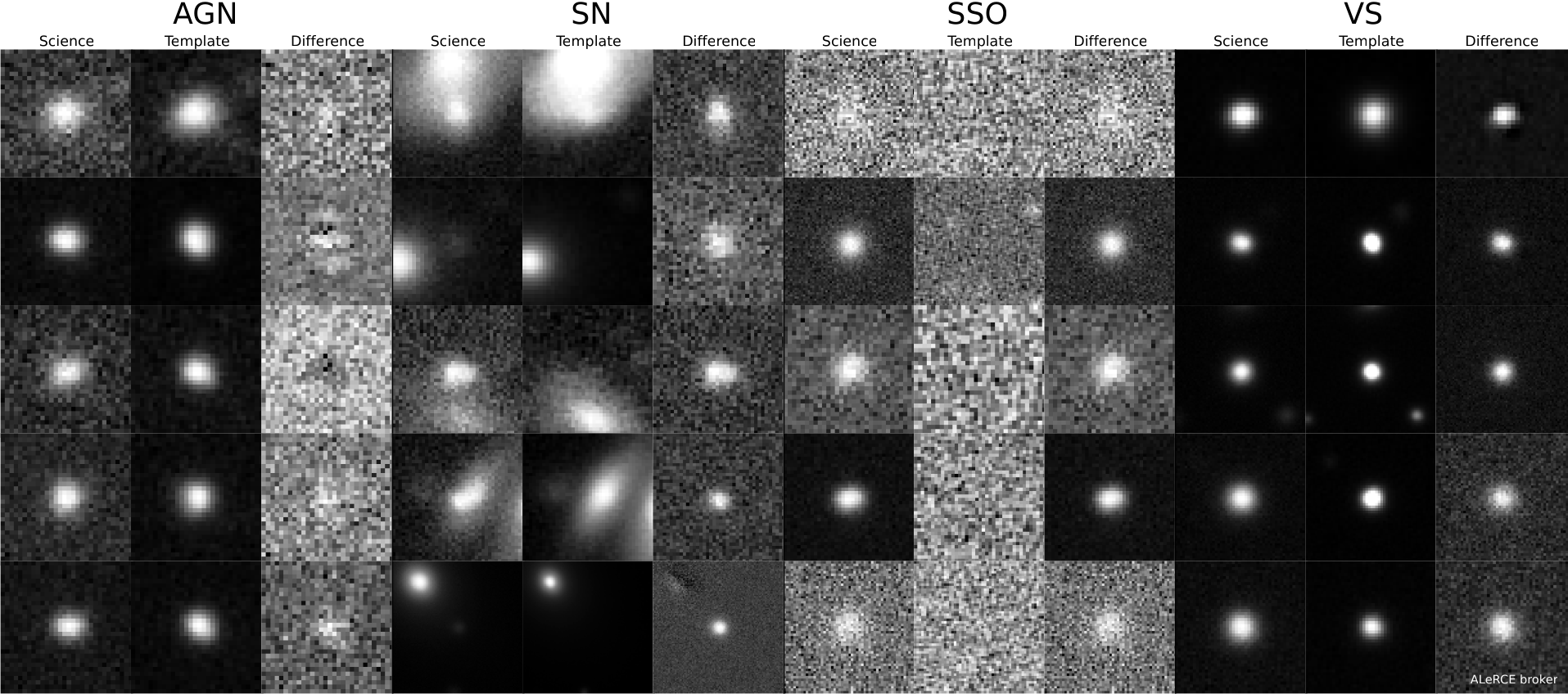
Image stamps also cover a significantly smaller area in the sky: 6″x6″ vs 31″x31′ in LSST and ZTF, respectively. This can be seen in the set of examples below containing Active Galactic Nuclei (AGN), supernovae (SNe), Solar System Objects (SSOs) and Variable Stars (VS):
Finally, LSST contains different surveys with different cadences, including a rolling strategy, resulting in very different light curves as can be seen in the following examples of simulated difference flux evolution of Superluminous SNe, SNe Ib, AGN and Mira stars in the Deep Drilling Field (DDF) and Wide Fast Deep (WFD) surveys.
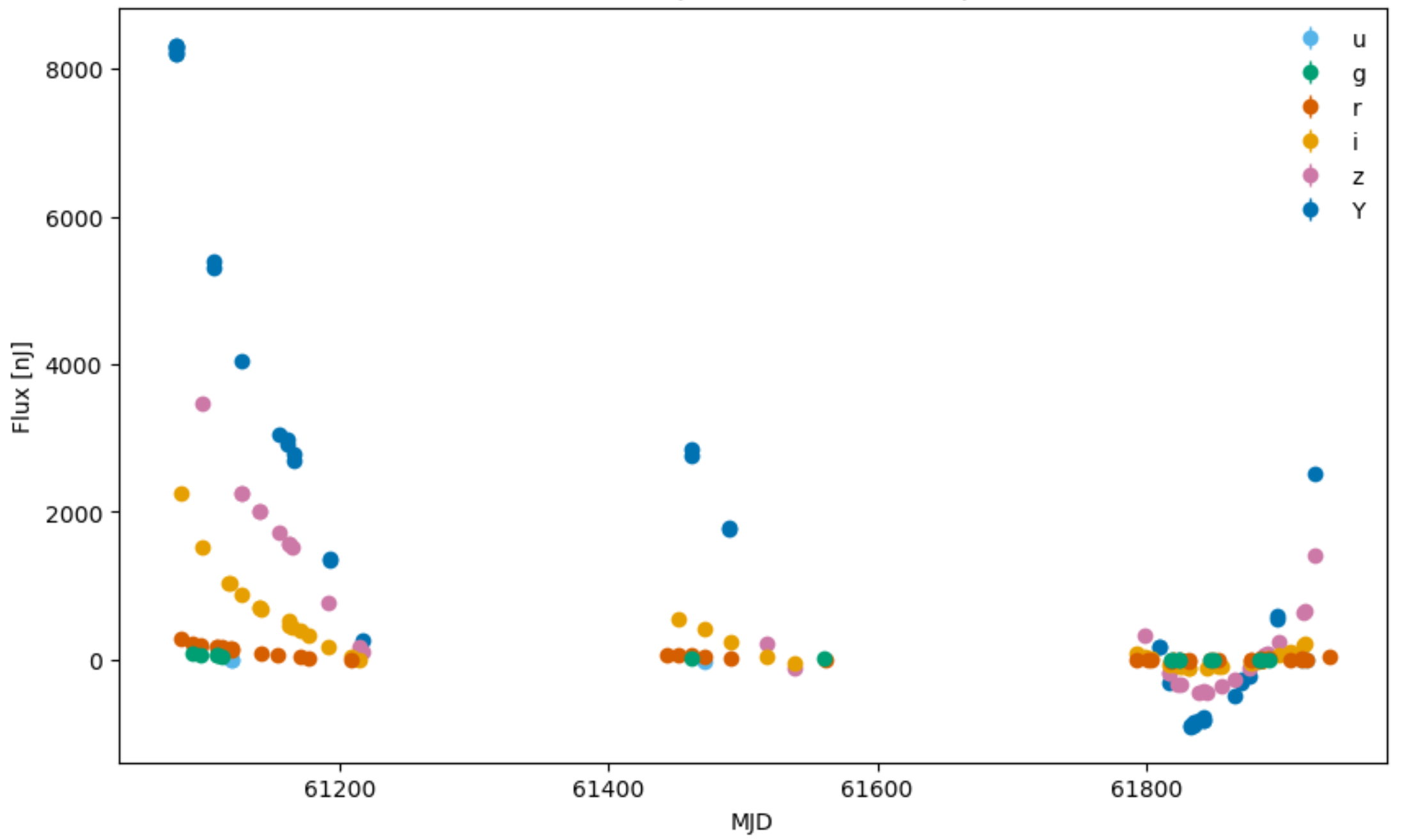
Simulated Superluminous SN in DDF
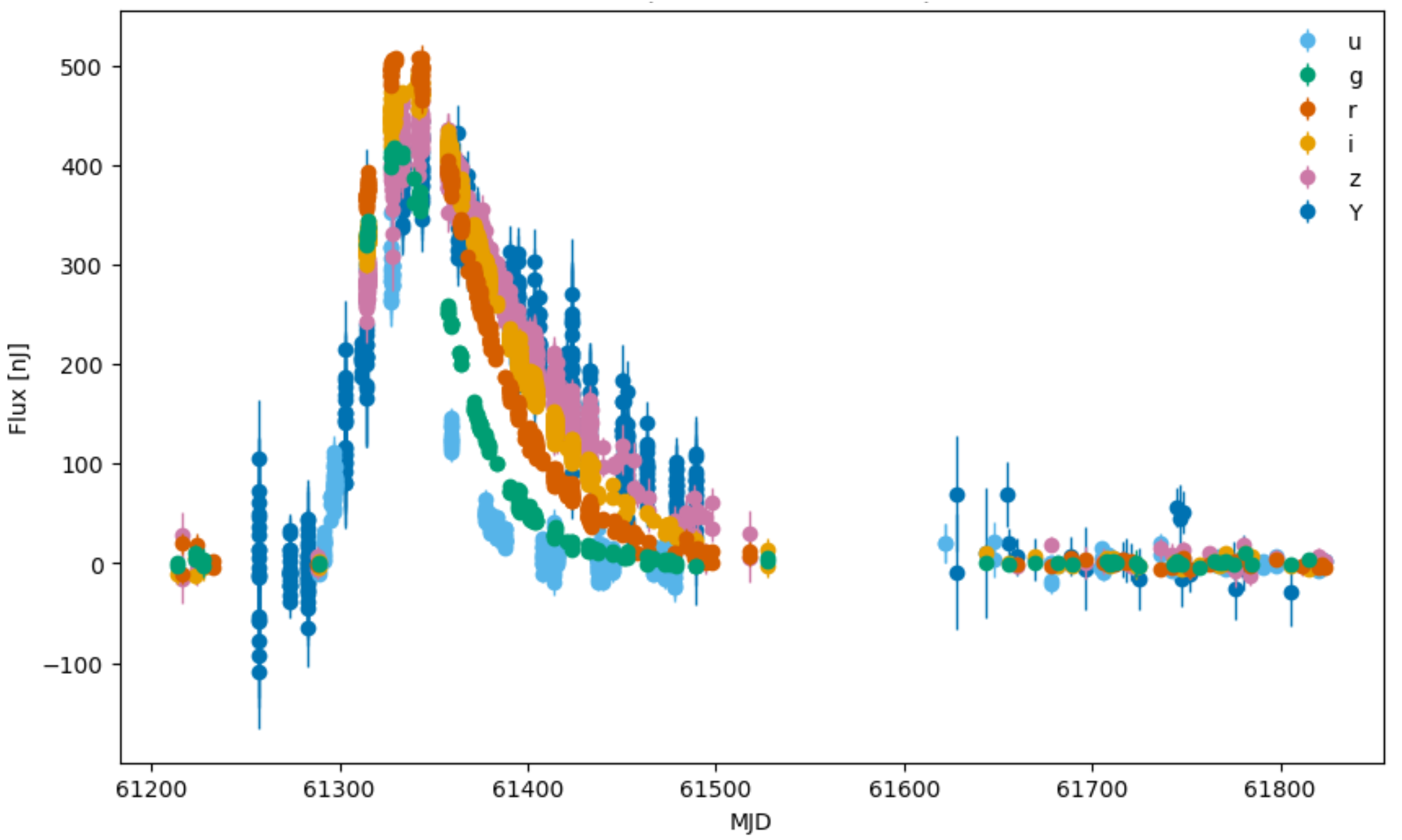
Simulated Superluminous SN in WFD
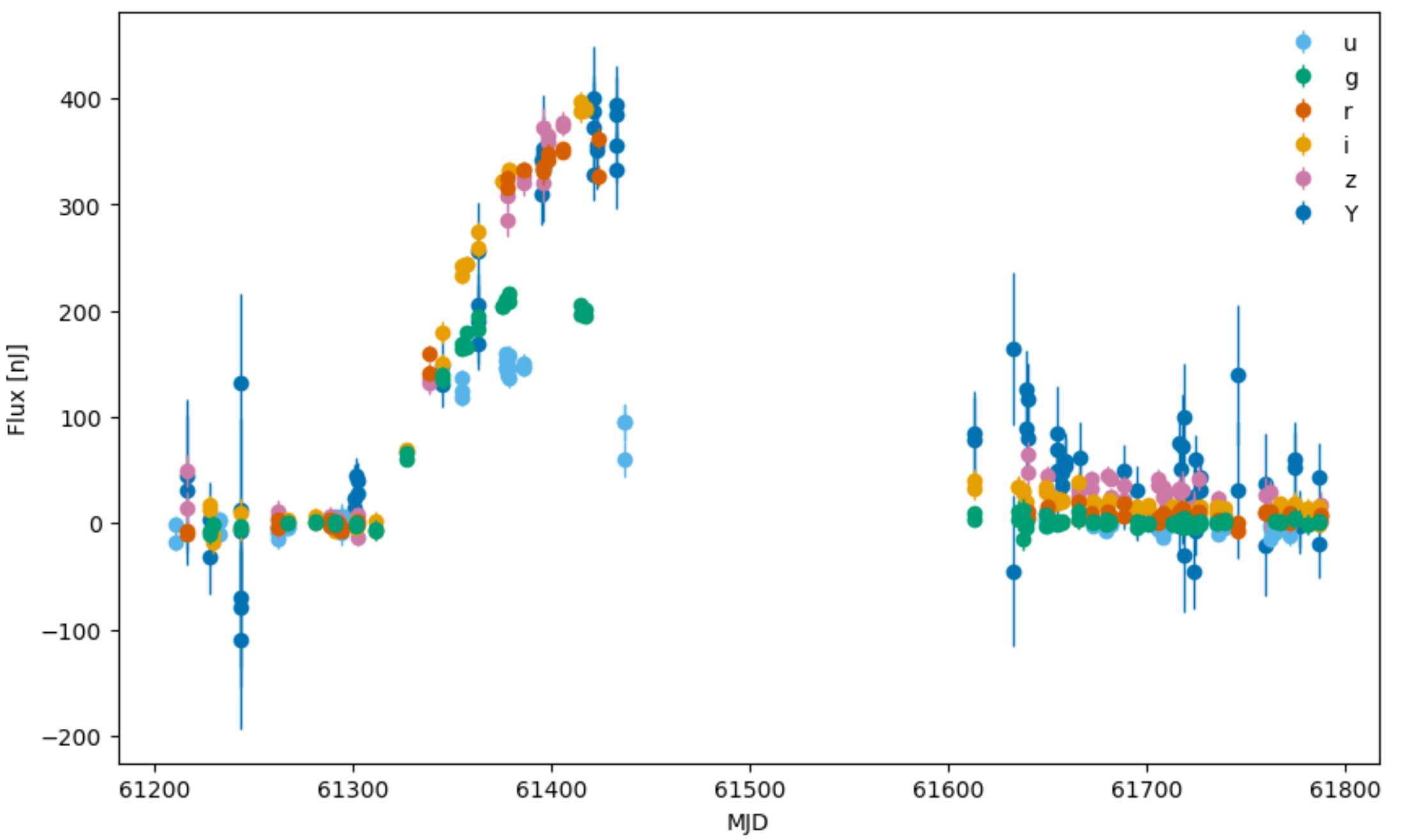
Simulated SN Ib in DDF
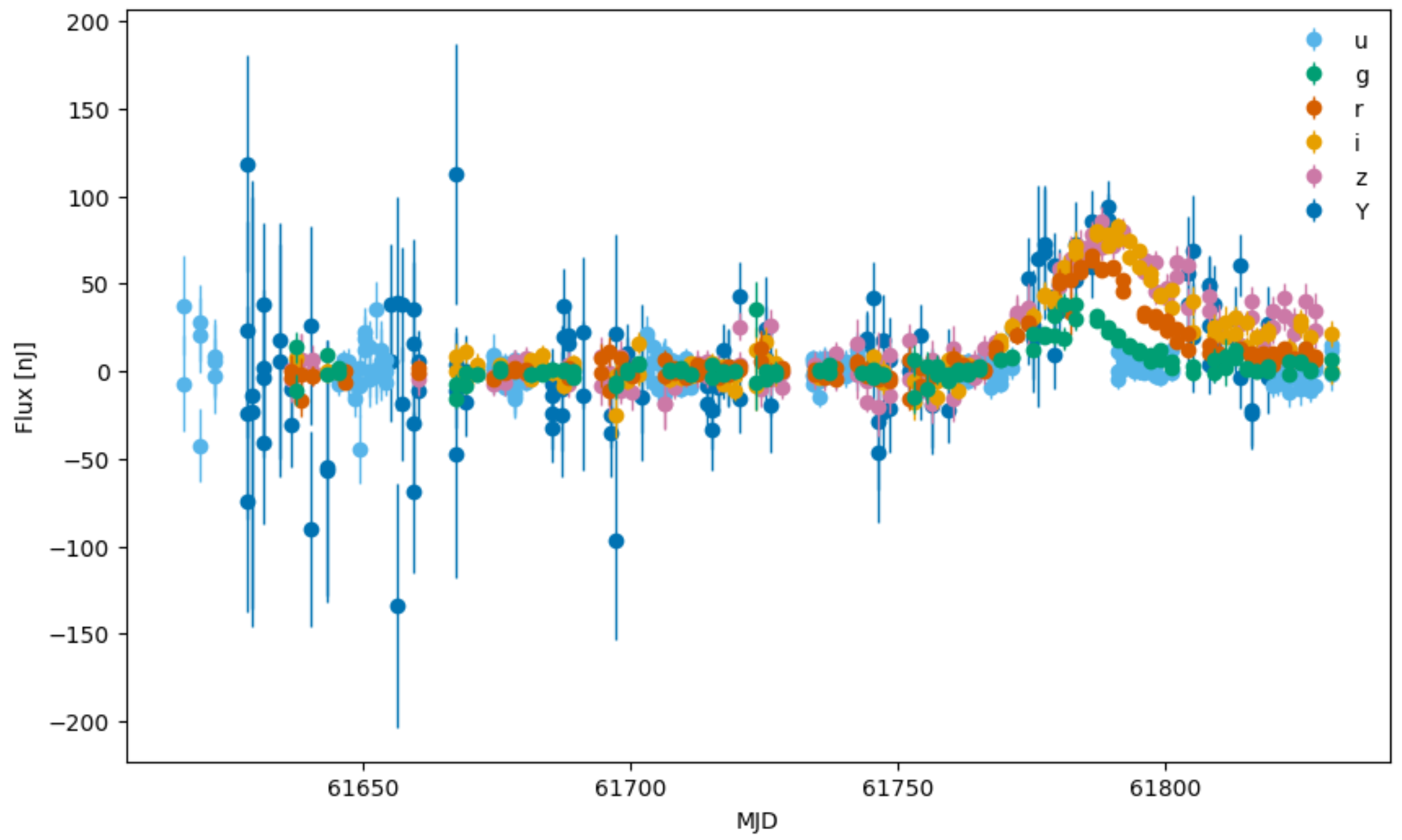
Simulated SN Ib in WFD
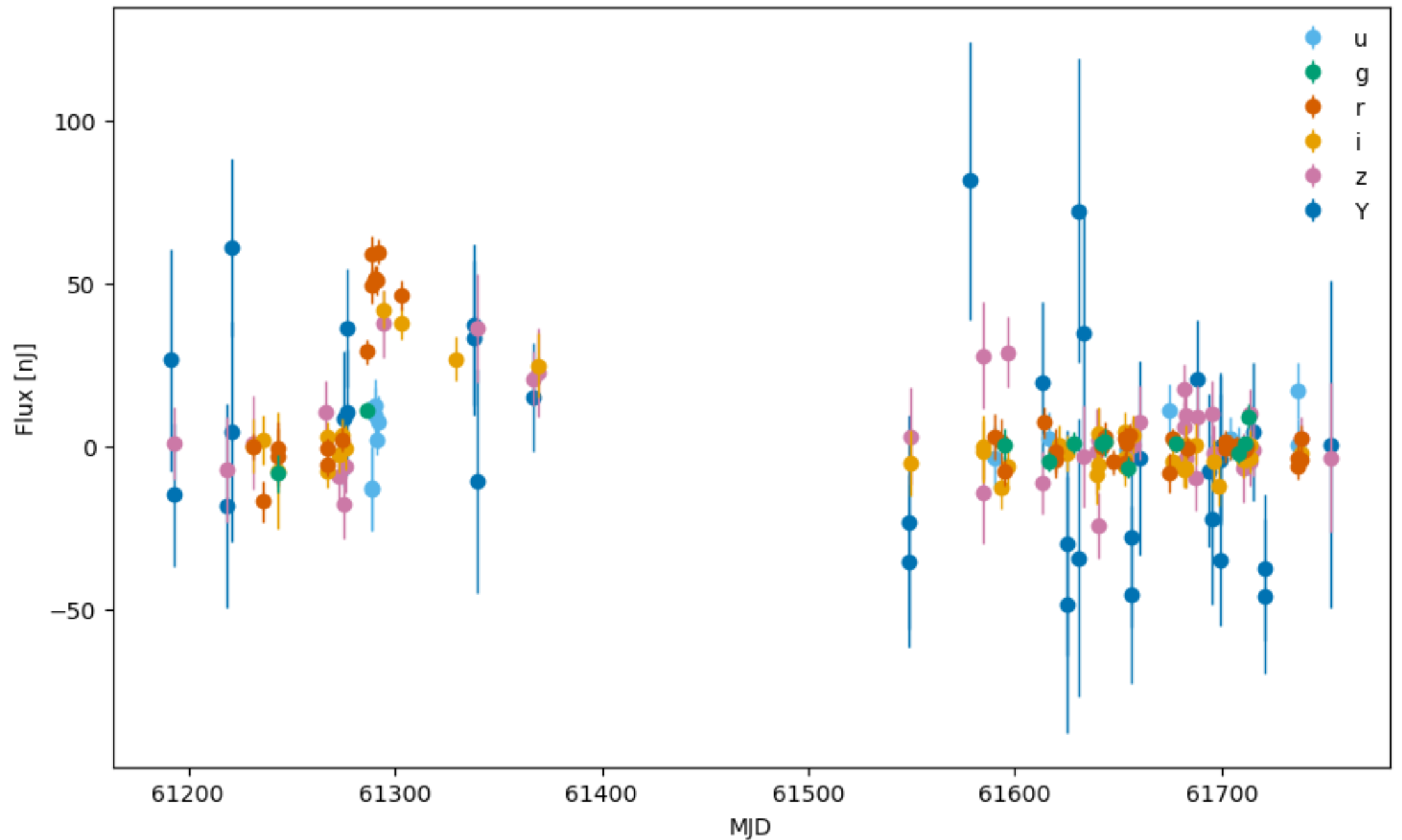
Simulated AGN in DDF
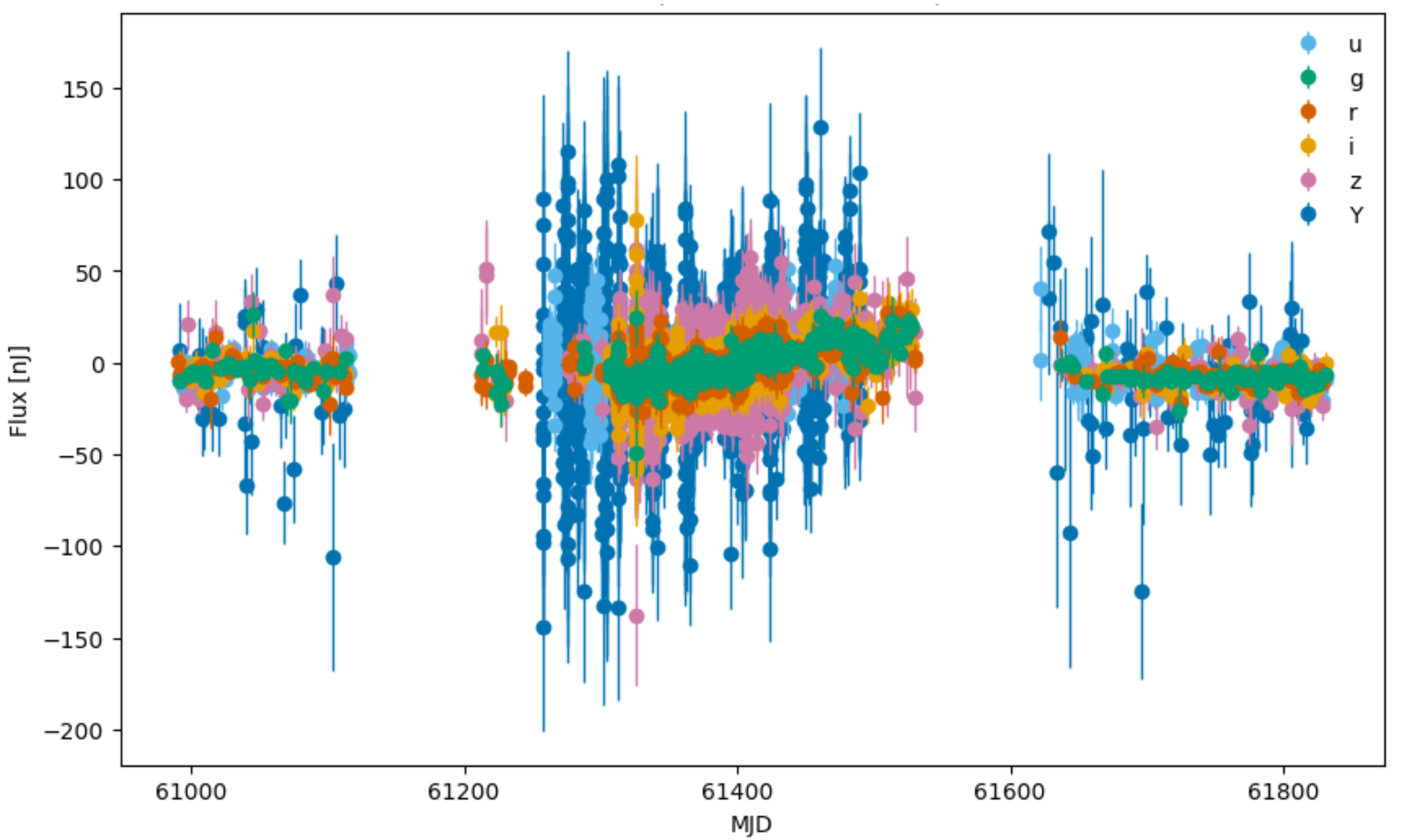
Simulated AGN in WFD
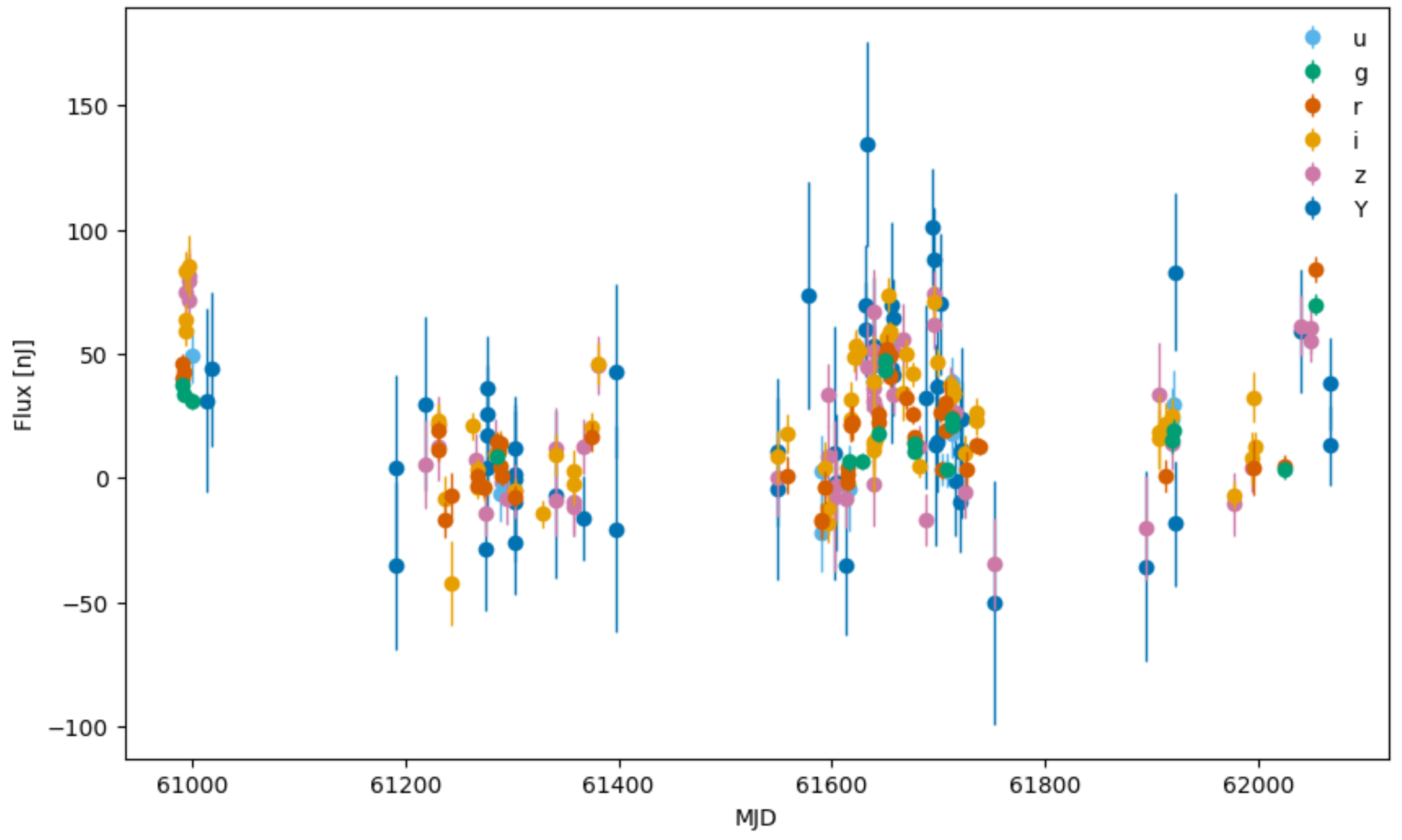
Simulated Mira star in DDF
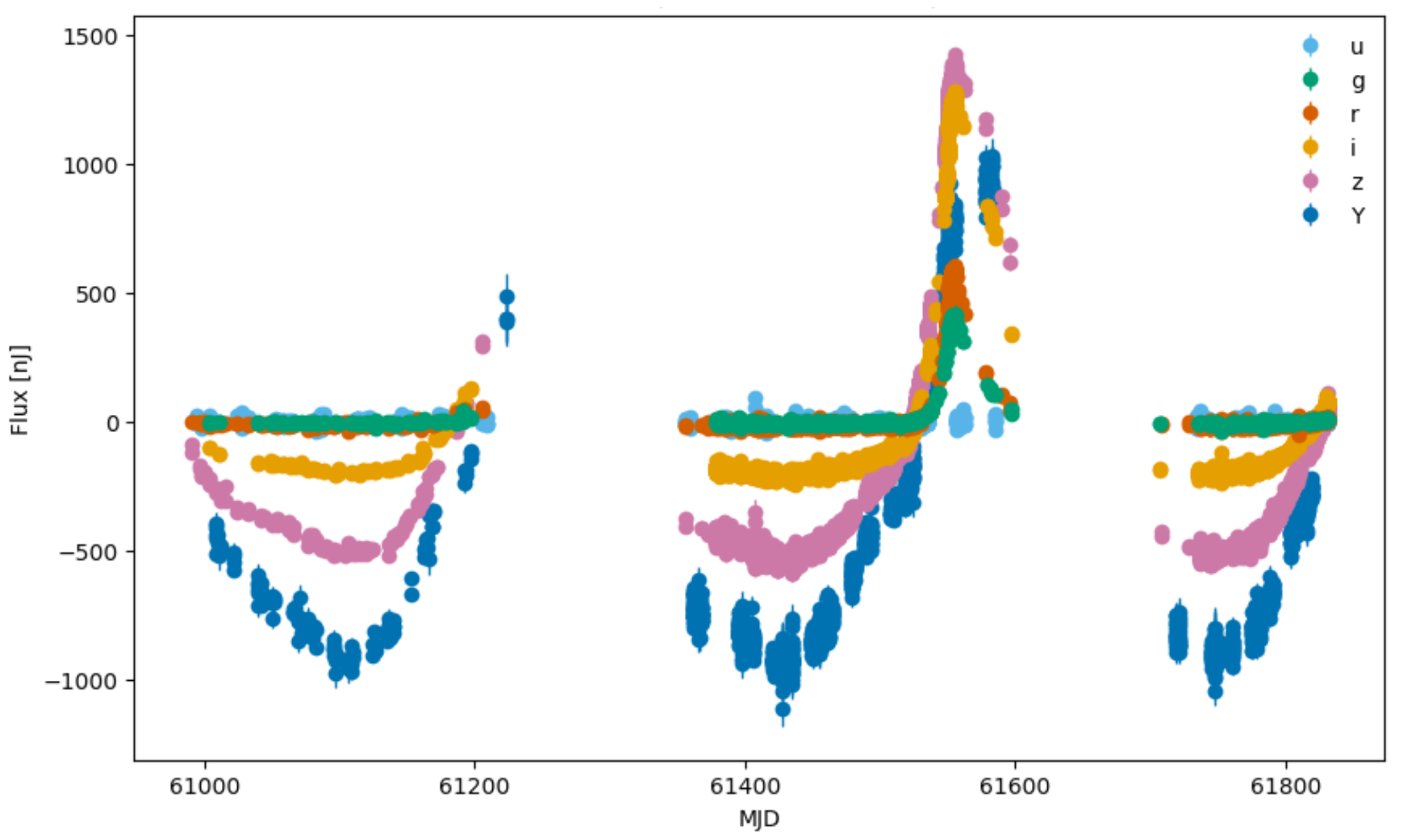
Simulated Mira star in WFD