From December 11 to 15, specialists from around the globe will gather in Puerto Varas on the eve of the beginning of a new era in astronomy.
In 2024 Chile and the world will witness an astronomical milestone that will revolutionize the study of the universe. From the summit of Cerro Pachón, in the Coquimbo region, the Vera Rubin Observatory will begin the test phase, or “commissioning”, of the systems that will allow – next year – the beginning of a decade of unprecedented scientific research called “Legacy Survey of Space and Time”.
This project, unique at the planetary level for its 3,200 megapixel digital camera, will produce an unprecedented astronomical catalog database, providing 20 terabytes of data per night and 200 petabytes at the end of its operation, which already challenges the scientific community to process data in real time.
A congress and a celebration
As a result of this and other scientific milestones, the Millennium Institute of Astrophysics (MAS), which is celebrating 10 years of operation, together with the Center for Mathematical Modeling (CMM) of the University of Chile, organized the international congress “Unveiling the dynamic universe: cosmic streams in the era of Rubin”, or simply Cosmic Streams, which will be held in Puerto Varas, in the Los Lagos region, from December 11 to 15, 2023.
“The main objective of this congress is to connect the search telescopes with the tracking telescopes, together with the brokers and the software infrastructure in general that help these systems to interact. Cosmic Streams will be where astronomy will begin to be designed for the next decades”, explains Francisco Förster, MAS-CMM researcher and director of ALeRCE, the Chilean broker that was chosen -along with six others worldwide- to analyze the Vera Rubin data.
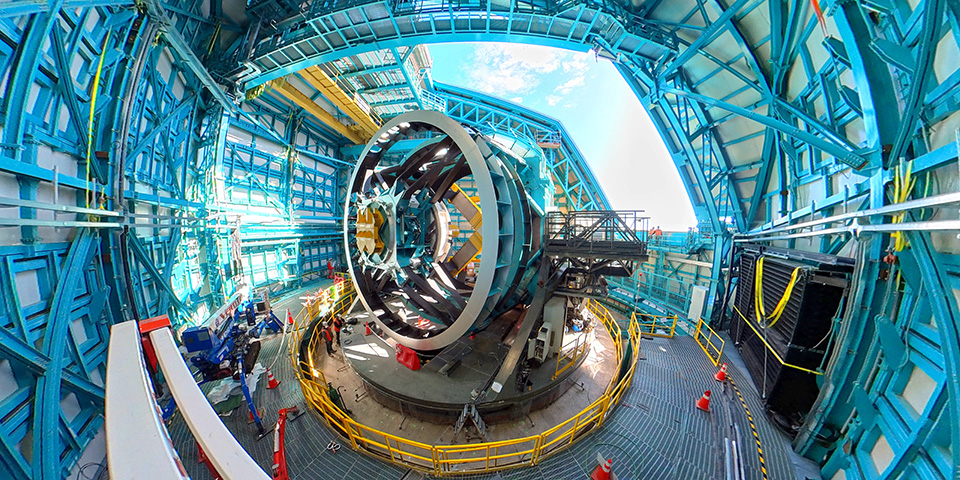
Panoramic view of the telescope mount inside the dome of Vera Rubin observatory.
ALeRCE, a project developed by MAS, CMM, Data Observatory and the Universidad de Concepción, has processed to date about 300 million alerts of objects and events in the universe, coming from other instruments such as the Zwicky Transient Facility (ZTF) – a large field-of-view telescope located in California, USA – which scans the entire sky every other night and is also modifying its way of operating, doubling and complexifying the amount of data released; and from ATLAS, a set of four telescopes located in the northern and southern hemisphere to track asteroids, one of which is located in the commune of Rio Hurtado in Chile, thanks to an alliance between MAS and the University of Hawaii.
“We are at a key moment in astronomy, as it is substantially changing the way we study the universe. New instruments mean being prepared to automate many processes, extract science using artificial intelligence, make the astronomical infrastructure more interoperable. For that you need to train the people in charge of that work, bring them together and get them on the same page. That is what this conference is all about, so it is not ambitious to say that the foundations for this new stage will be laid here”, says Förster.
Open talk
Cosmic Streams will feature prominent guests, including Leanne Guy, who leads the data processing and data management science team at Vera C. Rubin, and Matthew Graham, a researcher at Caltech and one of the ZTF’s lead scientists. In addition, a public talk on scientific dissemination will be held next Monday, December 11, at 19:00 hours, in the blue room of the Municipality of Puerto Varas.
By Alonso Farías, Center for Mathematical Modeling